Concept Sniper v1.0...

Barter to Blockchain – The History of FX and Stock Market Trading
LEARNING FOREX
1/15/2026
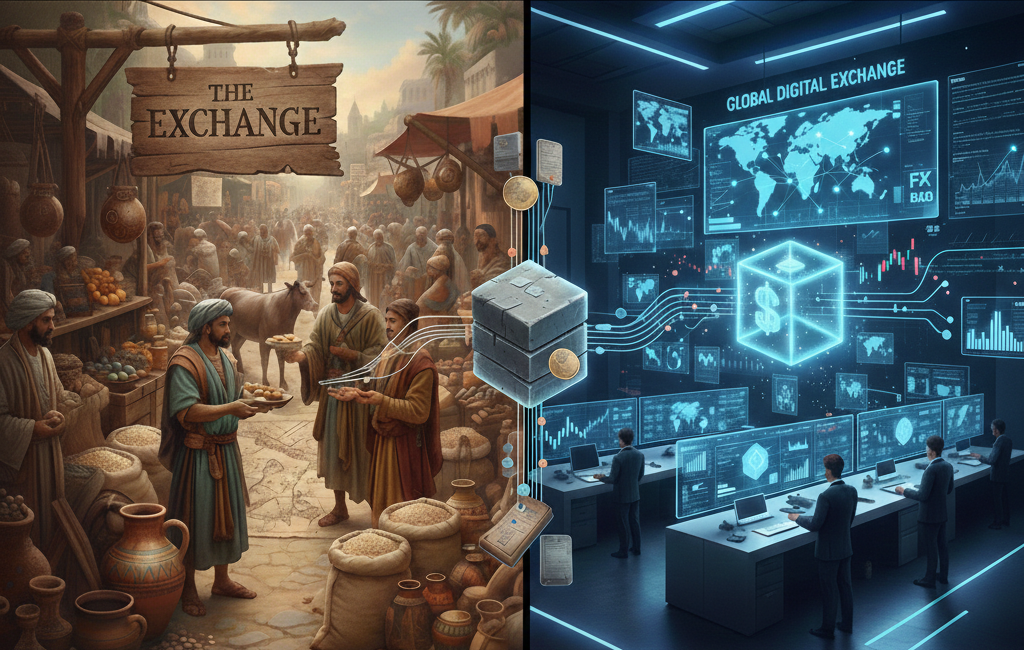
Trading has always been at the heart of human civilization. What began as simple barter — grain for cattle, salt for gold — has evolved into sophisticated financial systems where trillions of dollars move across global markets every day.
The history of foreign exchange (FX) and stock market trading is a story of innovation, economic growth, financial crises, and resilience. Understanding this journey helps traders appreciate how modern markets came to be and where they may be headed next.
The Birth of Currency Exchange (Forex Market History)
Long before modern banks and electronic trading platforms, merchants exchanged currencies to facilitate trade across regions.
Ancient Currency Exchange
Early civilizations such as Babylonia were among the first to establish exchange rates between different coins and commodities. These early systems laid the foundation for foreign exchange trading.
Amsterdam and the First Organized FX Markets
By the 16th century, Amsterdam emerged as a global trading hub. Merchants could exchange currencies alongside physical goods, marking the birth of organized currency markets.
The Gold Standard Era
In the 19th century, many nations adopted the gold standard, linking their currencies directly to gold. While this system provided stability, it limited economic flexibility.
Bretton Woods and Modern Forex
After World War II, the Bretton Woods Agreement (1944) pegged major currencies to the US dollar, which itself was backed by gold. When this system collapsed in 1971, floating exchange rates emerged—giving rise to the modern forex market.
Forex Today
Today, the FX market is the largest financial market in the world, with over $6 trillion traded daily, operating 24 hours a day, five days a week.
The Rise of Stock Markets
While currency trading evolved through commerce, stock markets developed to finance large business ventures.
Early Stock Exchanges
1602 – Amsterdam Stock Exchange: The Dutch East India Company issued shares, allowing public ownership in global trade.
1792 – New York Stock Exchange (NYSE): Formed under a buttonwood tree on Wall Street.
1801 – London Stock Exchange (LSE): Strengthened Britain’s dominance in global finance.
Key Milestones in Stock Market History
1929 Wall Street Crash: Triggered the Great Depression and reshaped financial regulation.
1970s–1980s: Electronic trading replaced paper-based systems.
2000s to Present: Algorithmic and high-frequency trading transformed markets, where speed and data now define success.
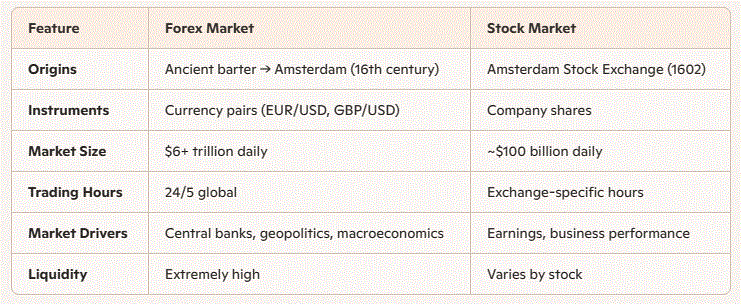
Forex vs Stock Market: Key Differences
Lessons from Trading History
Speculation and Market Bubbles
From Tulip Mania in the 1600s to the dot-com bubble, history shows that excessive speculation often leads to painful corrections.Regulation After Crises
Major events like 1929 and 2008 resulted in stronger financial regulations, aiming to balance innovation with market stability.Technology and Volatility
Technology has increased speed and access—from chalkboards to AI-powered trading—but volatility remains a constant feature of financial markets.
The Future: From Markets to Blockchain
The evolution of trading is far from over. Innovations such as blockchain technology, digital assets, and decentralized finance (DeFi) are shaping a new era.
Just as the gold standard gave way to floating currencies, today’s technologies may redefine how value is created, stored, and exchanged. Traders who understand history are better prepared to adapt to what comes next.
Final Thought
Markets change, tools evolve, and technology advances — but human behavior remains the core driver of trading. The lessons of the past continue to guide the traders of the future.
Contact
Reach out for personalized AI trading solutions
info@concepttradez.com
+49-15207219929
© 2026. Concept Tradez. All rights reserved.
support@concepttradez.com
Stay Connected
Company
Knowledge Hub
Services
Algo Trading
AI Assistance
Copy Trading
Custom Solutions


Trading in financial instruments involves substantial risk and there is always the potential for loss.
Your trading results may vary. Past performance is not indicative of future results.