Concept Sniper v1.0...

5 Negative Trading Habits That Slowly Make Traders Poor (And How to Fix Them)
3/11/20264 min read
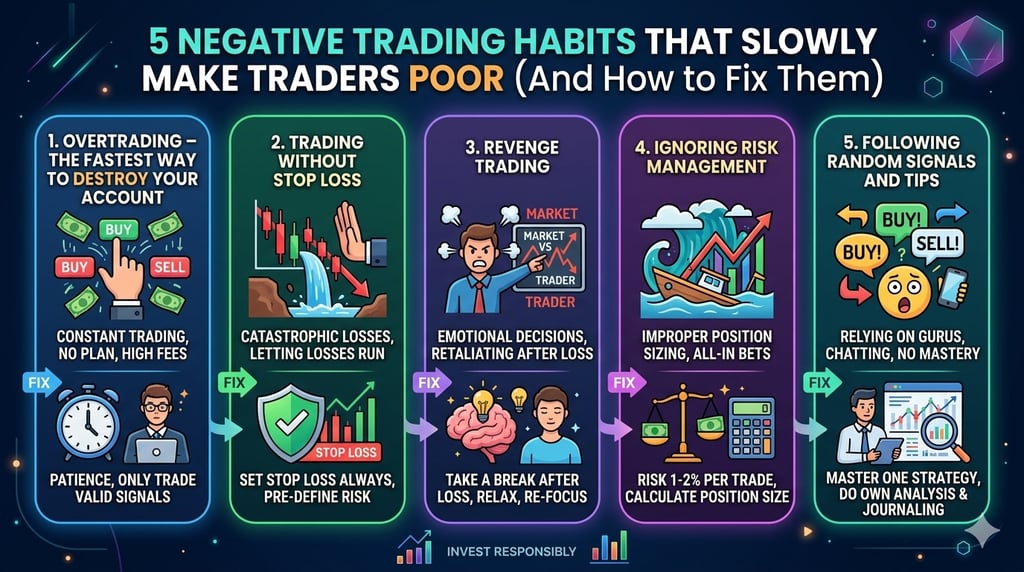
Many people enter the world of trading with dreams of quick profits and financial freedom. But the reality is very different. Most traders fail not because the market is too difficult, but because they develop habits that slowly destroy their trading accounts.
In this blog, we will discuss five negative trading habits that gradually make traders poor and how you can correct them to become a disciplined and profitable trader.
Trading success is not about luck. It is about discipline, risk control, and the right mindset.
1. Overtrading – The Fastest Way to Destroy Your Account
Overtrading is one of the most common mistakes traders make.
When you constantly watch charts, every small movement starts looking like a trading opportunity. Every breakout feels like the next big profit.
But the truth is:
Not every market move is a trading opportunity.
When traders start taking 10–15 trades per day, they are no longer trading—they are gambling.
Why Overtrading Happens
Overtrading usually happens because of two emotions:
Greed: After a small profit, traders think they have mastered the market and jump into another trade.
Revenge after Loss: After a loss, traders try to recover quickly by entering multiple trades without proper analysis.
The result?
More losses, more commissions, and emotional exhaustion.
How to Fix Overtrading
Follow these simple rules:
Limit yourself to 2–3 high‑quality trades per day
Only take trades that match your strategy setup
If the market is unclear, observe instead of trading
Remember: Trading is about quality, not quantity.
2. Trading Without Stop Loss
Trading without a stop loss is like driving a car without brakes. Many beginner traders avoid stop losses because they believe the market will eventually reverse.
But the market does not follow your hopes.
A small loss can quickly turn into a huge account‑destroying loss.
Professional traders always say: Protect your capital first. Profits will follow.
Why Traders Avoid Stop Loss
They believe they cannot be wrong
They expect the market to reverse
They want to avoid accepting a loss
But without a stop loss, one bad trade can wipe out months of profits.
The Solution
Before every trade:
Decide your risk level
Place a clear stop loss
Never risk more than 2% of your capital
Stop loss is not your enemy.
It is your protection.
3. Revenge Trading
Revenge trading is a dangerous psychological trap.
After losing a trade, the trader thinks:
"I will recover my loss immediately."
But trading does not work like that.
When emotions take control, logic disappears.
Instead of following a strategy, traders start making impulsive decisions.
The Revenge Trading Cycle
Loss → Emotional reaction → Bigger trade → Bigger loss
This cycle continues until the trader loses most of their capital.
How to Stop Revenge Trading
If you lose two trades in a day, stop trading.
Take a break.
The market will still be there tomorrow.
A calm mind always makes better decisions.
4. Ignoring Risk Management
Risk management is the foundation of successful trading, yet many traders ignore it.
Most beginners focus only on entry points or strategies, but professional traders focus on risk control.
Because every strategy has losses.
The real question is:
Can your account survive those losses?
Common Risk Management Mistakes
Using random lot sizes
Increasing position size emotionally
Risking too much capital in one trade
Averaging down losing trades
These mistakes slowly destroy accounts.
The Golden Rule of Risk Management
Never risk more than 2% of your trading capital per trade.
Example:
If your capital is $1,000, your maximum risk per trade should be $20.
This keeps your account safe even after multiple losses.
Risk management ensures long‑term survival in the market.
5. Following Random Signals and Tips
Today trading signals are everywhere:
Whatsapp Groups / Telegram channels
YouTube videos
Instagram reels
Twitter posts
Many traders blindly follow these signals without understanding the strategy behind them.
But trading is a personal business.
Your capital, risk tolerance, and psychology are different from others.
Following random signals destroys your ability to think independently.
Problems With Blindly Following Signals
No understanding of the strategy
No consistency
Dependence on others
Lack of discipline
Successful traders build their own systems.
They may learn from others, but they never blindly follow.
The Right Approach
Before taking a trade:
Analyze the chart yourself
Confirm the setup
Follow your own strategy rules
Consistency comes from having a system, not from chasing signals.
The Reality of Trading Success
Many people start trading thinking they will become rich within months.
But trading is not magic.
It is a serious business that requires patience, learning, and discipline.
Professional traders:
Follow the same strategy for years
Maintain trading journals
Analyze every loss
Focus on process, not shortcuts
The goal is not to get rich quickly.
The goal is to survive first, then grow consistently.
How to Break These Bad Trading Habits
Understanding mistakes is the first step.
The next step is building discipline.
Here are practical ways to improve your trading mindset.
1. Control Your Emotions
Trading is a psychological battle.
Four emotions destroy traders:
Greed
Fear
Hope
Anger
Professional traders do not suppress emotions. They recognize them and control their actions.
Having clear trading rules helps reduce emotional decisions.
2. Maintain a Trading Journal
A trading journal is one of the most powerful tools for improvement.
After every trading day, write:
Entry reason
Exit reason
Risk taken
Emotional state
Trade result
Over time, your journal will reveal your strengths and weaknesses.
This awareness leads to better discipline.
3. Create a Pre‑Trade Checklist
Before entering a trade, ask yourself:
Is the market structure clear?
Does this setup match my strategy?
Is my stop loss defined?
Am I emotionally calm?
If the answer is no to any of these questions, skip the trade.
Discipline begins with preparation.
4. Accept No‑Trade Days
You do not need to trade every day.
Sometimes the best trade is no trade.
Professional traders wait patiently for high‑probability setups.
Your goal should be monthly consistency, not daily action.
5. Commit to Continuous Learning
Markets evolve constantly. Successful traders invest time in:
Backtesting strategies
Studying charts
Reading trading books
Reviewing past trades
Even 2 hours of learning every weekend can significantly improve your trading skills.
Never stop learning. Because the day learning stops, growth stops.
Final Thoughts
If you eliminate these five habits:
Overtrading
No stop loss
Revenge trading
Poor risk management
Following random signals
You will already be ahead of most traders. Success in trading does not come from shortcuts.
It comes from discipline, patience, and consistent learning.
Focus on building the right habits, and profits will follow.
How ConceptTradez Helps Build Wealth
ConceptTradez focuses on:
Systematic trading for wealth growth
Passive income through trading technology
Automated trading systems
Risk‑controlled investment structure
Our approach combines disciplined investing strategy + automation + risk control.
👉 Learn more: concepttradez.com
👉 Automated systems: concepttradez.com/ea
👉Trading education: concepttradez.com/blog
Contact
Reach out for personalized AI trading solutions
info@concepttradez.com
+49-15207219929
© 2026. Concept Tradez. All rights reserved.
support@concepttradez.com
Stay Connected
Company
Knowledge Hub
Services
Algo Trading
AI Assistance
Copy Trading
Custom Solutions


Trading in financial instruments involves substantial risk and there is always the potential for loss.
Your trading results may vary. Past performance is not indicative of future results.